 how-to
How to Choose Veteran-Owned Plumbing Services
Last Updated: November 1, 2026
Quick Summary
Veteran-owned plumbing brings a working culture shaped by military accountability: show up on time, document the job, and finish what you start. The benefits come from the habits behind the badge, not the badge itself, so verify ownership and licensing before you book.
- A veteran-owned business is one where a military veteran holds majority ownership.
- Verifying a veteran-owned business takes about ten minutes using public records and directories.
- Confirm the license number with your state's licensing board rather than trusting a logo on a truck.
- Ask about general liability coverage and workers' compensation before hiring any plumber.
- Compare written quotes line by line, not by the bottom number, since cheap bids often omit permits.
Table of Contents
- Why Veteran-Owned Plumbing Services Deliver More Than a Badge
- How to Verify a Veteran-Owned Business Before You Book
- Plumber License and Insurance: What Every Homeowner Should Check
- Questions to Ask a Plumber Before Hiring
- Plumbing Estimates and Written Quotes: How to Compare Them Fairly
- Book Your Veteran-Owned Plumbing Service with Aim Plumbing California
- Frequently Asked Questions
Why Veteran-Owned Plumbing Services Deliver More Than a Badge
The benefits of veteran owned plumbing services start with how the owner was trained to work. Military service builds habits that translate directly into home repairs: show up on time, document the job, and finish what you start.
A veteran-owned business is a company in which a military veteran holds majority ownership. That status is more than a label. It signals a working culture shaped by accountability.
Here is the part most people miss. The badge itself fixes nothing. What matters is whether the habits behind it show up in your kitchen at 7 a.m. on a Tuesday.
Discipline, Accountability, and Attention to Detail
Discipline in plumbing looks boring, and boring is good. It means the shutoff valve gets labeled. It means the crawlspace gets inspected before anyone quotes a price.
Veterans are often trained to follow a checklist every single time, not just when it is convenient.
- Jobs get documented in writing
- Tools and parts get accounted for
- Timelines get set and met
- Cleanup happens before the truck leaves
How Military Experience Translates to Better Home Repairs
Military work rewards precision and teamwork under pressure. A burst pipe at midnight is a small version of that.
Service members also train in logistics and equipment maintenance. Both matter when a repair needs the right part, not a guess.
How to Verify a Veteran-Owned Business Before You Book
Verification takes about ten minutes, and it protects you from marketing claims that never get checked. Ask directly, then confirm.
Use this checklist before you book:
- Ask what branch and years of service the owner has
- Request the owner's name and check it against public records
- Look for the business in a veteran business directory
- Search state business registration records
- Ask for proof of service-disabled veteran-owned status if claimed
- Confirm the license number with the state licensing board
A veteran-owned company should be able to answer these questions clearly.
The U.S. Small Business Administration's veteran business resources explain how veteran-owned status is defined and what documentation supports it.
Plumber License and Insurance: What Every Homeowner Should Check
A license and active insurance are the two non-negotiables. Skip either one and you carry the risk.
A licensed plumber has met state requirements for training and testing. Licensing rules vary by state, so confirm the number with your state's licensing board rather than trusting a logo on a truck.
Insurance matters just as much. Ask about two types of coverage:
- General liability coverage, which protects your property
- Workers' compensation, which covers injuries on your job
Call the insurer if you want certainty. A certificate is easy to print. An active policy is not.
Watch out: hiring an uninsured plumber can leave a flooded floor or an injured worker as your responsibility.
Questions to Ask a Plumber Before Hiring
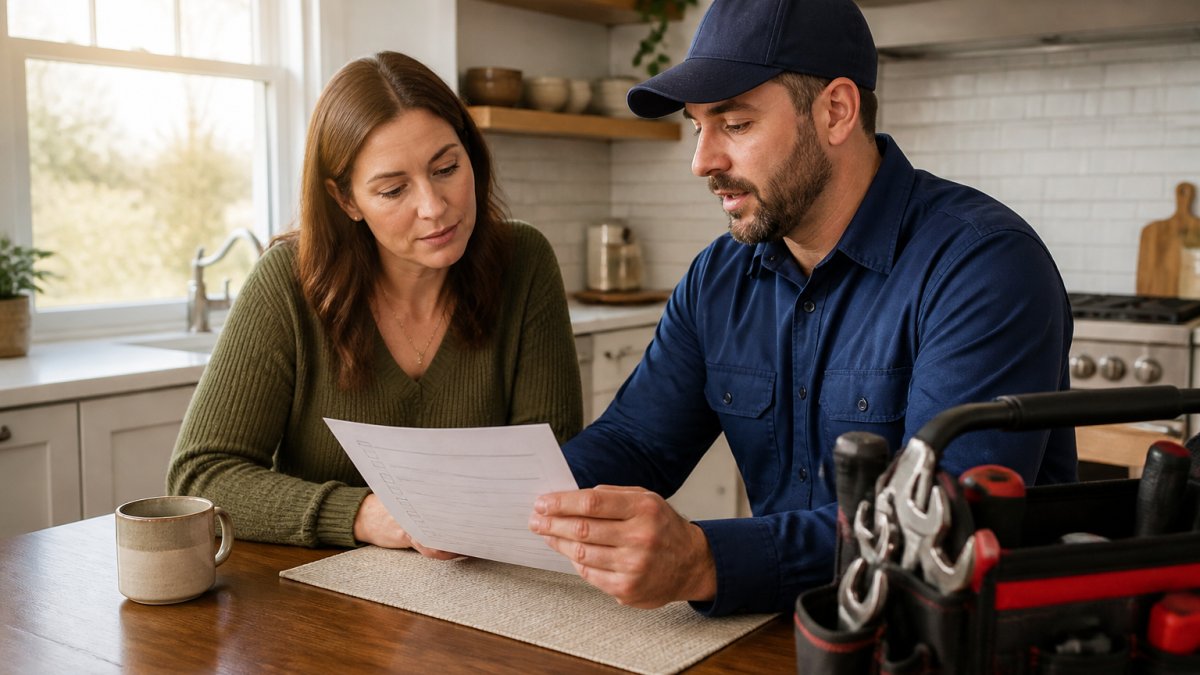
The best predictor of a good experience is how a plumber answers questions before money changes hands. Ask these plainly and listen for specifics. The goal is not to stump anyone, it is to see whether the answers are concrete, consistent, and put in writing.
Step 1: Confirm the basics before you talk scope
Start with identity and credentials, because everything else depends on them:
- What is the owner's name, and is the business veteran-owned or service-disabled veteran-owned?
- What is the license number, and which state board issued it?
- Can you send a certificate of insurance showing general liability and workers' compensation?
- Who will actually be on site, the owner, an employee, or a subcontractor?
A veteran-owned company should be able to answer these without hesitation. If a company claims service-disabled veteran-owned status, ask for the documentation that supports it rather than accepting a logo on a truck.
Step 2: Pin down scheduling and pricing
Then move to the terms that drive cost and timing:
- How soon can you arrive, and will you call ahead?
- Is there a diagnostic fee, and does it apply to the repair if I approve the work?
- Will I get a written quote before work starts, and what is excluded from it?
- What happens if the job takes longer than quoted, is the rate hourly or flat?
- Are permits included, and who pulls them?
Listen for specifics. "It depends" is a fair answer only when followed by what it depends on.
Step 3: Ask about the work itself
- Who do I call if something fails next month, and what is the response time?
That last question helps separate one-time service providers from companies that stand behind their work.
Step 4: Read the answers for red flags
A few patterns should give you pause:
- A quote given over the phone without seeing the problem, presented as final
- Pressure to approve work before you have a written scope
- No license number, or a number that does not match the state board record
- A warranty described verbally but not included in the contract
- A crew that cannot name who employs them
Step 5: Compare like with like
Ask every plumber the same questions and keep the answers side by side. The FTC guidance on home repair contracts describes the terms a written contract should include, which gives you a neutral checklist for comparing what each company puts in writing.
Plumbing Estimates and Written Quotes: How to Compare Them Fairly
A written quote is the only fair way to compare plumbers, because verbal numbers hide the details that drive cost. Get everything in writing before you approve anything.
Plumbing estimates and written quotes should list the same four things every time:
| Quote Element | What to Look For | Why It Matters |
|---|---|---|
| Scope of work | Exact repair or install listed | Prevents surprise add-ons |
| Parts and materials | Brand and grade named | Cheap parts fail early |
| Labor terms | Hourly or flat rate stated | Flat rates cap your risk |
| Warranty | Labor and parts coverage | Protects repeat repairs |
Compare line by line, not by the bottom number. The cheapest bid often leaves out permits, haul-away, or the second visit you will need.
Ask each plumber the same questions so the comparison stays honest. Then check the quote against the FTC guidance on home repair contracts for the terms a written contract should include.
Book Your Veteran-Owned Plumbing Service with Aim Plumbing California
Choosing a plumber is a trust decision, and the paperwork only proves so much. The rest comes down to whether the crew shows up, explains the work, and stands behind it. That is where veteran-owned plumbing earns its keep.
Aim Plumbing California serves residential and commercial customers in the Hemet area. Visit our website for current service details and a quote.
Get started with Aim Plumbing California. Contact us through our website for current service details and a quote.
Frequently Asked Questions
What are the benefits of hiring a veteran-owned plumbing company?
Veteran-owned plumbing companies often bring discipline, clear communication, and a strong sense of accountability to every job. Owners with military backgrounds are used to following procedures precisely and documenting their work, which can mean fewer callbacks and more predictable timelines. The biggest benefit is a service culture built on reliability and respect for your property, not just a marketing label. Ask about warranties and written estimates to confirm those standards apply to your project.
How can I verify that a plumbing business is veteran-owned?
Start by asking directly how the owner served and in which branch. Then check state or national veteran business directories and look for a service-disabled veteran-owned small business (SDVOSB) certification if applicable. Cross-reference the business name and license number with your state licensing board. A legitimate veteran-owned plumber will answer these questions without hesitation and can usually point you to directory listings or certification documents. If the ownership claim feels vague or evasive, treat it as a red flag.
What should I ask before hiring a plumber?
Ask for the plumber's license number and proof of insurance, including general liability and workers' compensation. Request a written estimate that itemizes labor, materials, and any diagnostic fees. Ask about warranty terms on both parts and labor, response times for emergencies, and whether the same crew will handle follow-up visits. Confirm how change orders are approved if the scope grows. Also ask how they handle cleanup and whether permits are included. Clear answers to these questions separate professional outfits from fly-by-night operators.
How do I compare plumbing estimates fairly?
Compare line by line, not just the bottom number. A low quote may exclude permits, haul-away, or quality fixtures. Check that each estimate lists the same scope: pipe materials, fixture brands, labor hours, and warranty length. Ask whether the price is fixed or time-and-materials, and how extra work gets approved. Get at least three written quotes and look for consistency in what is included. The cheapest bid often costs more later if it skips code-required steps or uses low-grade parts.